To be a valuable global supplier
for metallic honeycombs and turbine parts


Contact number
0555-2813555
To be a valuable global supplier
for metallic honeycombs and turbine parts
Technological Innovation
Process Management
Continuous Improvement
Customer Satisfaction

Knowledge
Dedication
Diligence
Loyalty
Responsibility
Confidence
Tenacity
Respect

To be a valuable global supplier
for metallic honeycombs and turbine parts
Release time:2026-03-25
I get asked a lot about what we actually do here. Not the sales pitch version. The real version. What happens on the shop floor, what we're good at, what we're not. Here's the honest answer.
What We Make
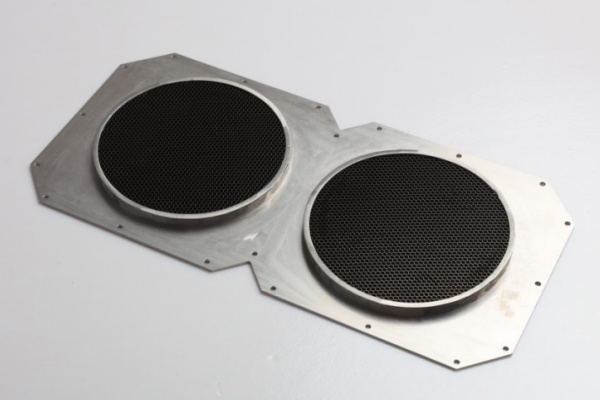
Planar waveguide vents are those honeycomb panels you see on electronic enclosures that need both airflow and shielding. They let air move through while keeping electromagnetic interference where it belongs. The principle is waveguide below cutoff—small openings, proper depth, signals can't get through.
We've been making these for years. Telecom cabinets. Military shelters. Medical equipment. Data centers. Anywhere gear needs to breathe but stay tight.
The Foil Is Where It Starts
Every vent starts with metal foil. Thin stuff. Thinner than what most people realize.
We use aluminum for most applications. Light. Conductive. Easy to form. For coastal or marine jobs, we use stainless steel 316L. Costs more, but salt doesn't eat it.
The foil comes in coils. We check it when it comes in. Thickness has to be consistent. Surface has to be clean. Any oil or oxidation messes up the brazing later. We've learned to test incoming material before it ever touches the forming equipment.
Forming the Cells
The foil goes through forming rolls that turn flat metal into corrugated shapes. Two corrugated layers stacked together make the honeycomb cells.
This is where precision matters. The cell size determines the cutoff frequency. Get it wrong and the vent won't shield what it's supposed to shield. We check cell dimensions regularly. Tools wear. We replace them before the parts drift out of spec.
For standard honeycomb, the process is straightforward. For planar waveguide—where the cells are oriented straight through instead of angled—the forming is the same but the stacking changes. The layers stack flat instead of rolled into a cylinder. Sounds simple. It's not. Keeping everything aligned across a large flat panel takes fixturing that most shops don't have.
Stacking and Fixturing
This is the part that separates us from a lot of other shops.
Round honeycomb for catalytic converters? Easy. Roll it, braze it, done.
Flat panels for waveguide vents? Different story. You're stacking layers that can be two feet across or more. Everything has to line up. The cells have to be straight through. Any shift during stacking creates misalignment. Misalignment means uneven flow and compromised shielding.
We built our own fixturing for this. Clamps that hold the stack square while it goes into the furnace. Tooling that keeps the layers from shifting during the brazing cycle. It took years to get this right. Now it's just how we work.
Brazing
The furnace is where it all comes together.
Brazing is how the layers bond to each other and to the frame. The stack goes in with a filler material between the layers. The furnace heats it to the right temperature—hot enough to melt the filler, not hot enough to melt the foil.
Temperature control is everything. Too low, the filler doesn't flow. The layers don't bond. The vent looks fine but falls apart under vibration. Too high, the filler runs where it shouldn't. Cells clog. Frames distort.
We run test cycles regularly. Check the temperature profile. Check the atmosphere in the furnace. We know what a good braze looks like coming out. The color tells you. The feel tells you. New guys learn from the old guys.
Frame Integration
The honeycomb doesn't do anything by itself. It needs a frame. The frame mounts to the enclosure. It holds the gasket. It makes the electrical connection.
We make frames from the same material as the honeycomb. Aluminum frame with aluminum honeycomb. Stainless frame with stainless honeycomb. Mixing metals creates galvanic corrosion. We don't do it.
The honeycomb brazes directly to the frame. One operation. The whole assembly comes out of the furnace as one piece. Some shops braze the honeycomb first, then weld it to the frame. That's an extra step. It adds cost. It also adds potential failure points. We prefer to do it in one shot.
Sealing
A vent that leaks around the edges isn't a vent. It's a hole.
We use silicone rubber gaskets for most applications. Closed-cell construction. Water doesn't soak through. Stays flexible over years of thermal cycling.
For jobs that need more, we do conductive gaskets. Silver-filled silicone or something similar. Maintains electrical continuity around the whole perimeter. Keeps the shield intact.
Some applications call for dual seals. One for EMI, one for weather. Separate materials. Separate jobs. Works better than trying to do both with one gasket.
Testing
We test everything. Not samples. Not every tenth piece. Every vent gets tested before it leaves.
Airflow. We measure pressure drop at a standard flow rate. If it's too high, something's wrong with the cell structure. If it's too low, maybe the cells are damaged or missing.
Dimensions. Every vent gets measured. Length, width, thickness, flatness. If it doesn't fit the customer's enclosure, it doesn't ship.
Shielding effectiveness. This one's the tricky part. We test samples from every batch on a spectrum analyzer. Not every single vent—that would take forever. But every batch gets tested. We know what the numbers should be. If they're off, we figure out why before anything ships.
We also do salt spray testing on marine-grade vents. 96 hours, sometimes longer. If it corrodes, it doesn't ship.
Custom Sizes and Shapes
Round is easy. Square is easy. Everything else is custom.
We've made waveguide vents in shapes you wouldn't believe. D-shaped to fit around other components. Oval to match an existing cutout. Rectangles with notches for mounting hardware. One-offs for prototypes. Production runs for military shelters.
Each shape needs its own tooling. Forming rolls. Stacking fixtures. Brazing fixtures. We build them in-house. That's why we can do custom work faster than shops that have to outsource tooling.
Lead time depends on whether the tooling exists. If we've made the shape before, we can ship in a few weeks. If it's something new, figure six to eight weeks for the first batch. The second batch moves faster.
What We Don't Do
I'll be honest about what we're not good at.
We don't do huge volume consumer stuff. If you need 50,000 identical vents for a mass-market product, there are shops better suited for that. We do the mid-volume stuff. Hundreds. Thousands. Not tens of thousands.
We don't do quick-turn prototypes for someone who needs a one-off in three days. We're set up for production. Prototypes take as long as production runs. If you need one vent fast, we're probably not your best option.
We don't cut corners on materials. Some shops use cheaper foil or skip the testing to hit a price point. We don't. That means we're not the cheapest. We're the ones who make parts that last.
The Stuff We've Learned
We've been doing this long enough to know what works and what doesn't.
We learned early that mixing metals is a bad idea. Stainless honeycomb in an aluminum frame looks fine when it goes out. A year later, the frame corrodes around the joint. Now we match materials or we don't do the job.
We learned that gaskets aren't optional. Had a customer years ago who wanted to save money by skipping the gasket. They bolted the vent directly to the enclosure. It leaked. EMI got in. They called us to figure out why. We sent them gaskets. Problem solved.
We learned that testing is cheaper than warranty claims. A vent that fails in the field costs more than catching it at the bench. We test hard so we don't have to explain later.
Why People Come to Us
I think the main reason customers stick with us is consistency.
We ship the same part every time. Not close. The same. Same cell size. Same dimensions. Same shielding numbers. Same gasket. When a customer gets a shipment, they know what's in the box.
We're also honest about lead times. If we can't ship by a certain date, we say so. We don't promise what we can't deliver. That's rare in this business, I've learned.
And we stand behind what we make. If something fails and it's our fault, we make it right. That doesn't happen often, but when it does, we take care of it.
Bottom Line
Making planar waveguide vent isn't magic. It's precision forming, controlled brazing, careful assembly, and thorough testing. It's knowing what materials work where. It's having the fixturing to do custom shapes without losing your mind.
We've been doing it long enough to know what matters and what doesn't. We're not the biggest shop out there. We're not the cheapest. But we make parts that work, on time, every time. For the customers who need that, it's enough.