To be a valuable global supplier
for metallic honeycombs and turbine parts


Contact number
0555-2813555
To be a valuable global supplier
for metallic honeycombs and turbine parts
Technological Innovation
Process Management
Continuous Improvement
Customer Satisfaction
Knowledge
Dedication
Diligence
Loyalty
Responsibility
Confidence
Tenacity
Respect

To be a valuable global supplier
for metallic honeycombs and turbine parts
Release time:2026-03-20
I've been in enough cell sites over the years to know these cabinets are always a compromise. You want airflow, so you open things up. You want shielding, so you close things back down. And somewhere in the middle, you try to make both work.
5G made that harder. Not a little—a lot. Higher frequencies. More heat. More gear stuffed into the same box. And that waveguide plate that used to just sit there doing its job? Now it matters more than it used to.
What Changed
Before 5G, you could get away with a basic vent. Punch some holes, throw a mesh over it, call it done. Frequencies were low enough that small openings didn't leak much. Heat loads were manageable.
Then 5G came along. Now you're dealing with millimeter-wave bands—28 GHz, 39 GHz, sometimes higher. At those frequencies, the wavelength is tiny. A gap that didn't matter at 2 GHz becomes a pretty good antenna at 30 GHz. Signals get in. Signals get out. Neither one is what you want.
Heat got worse too. A modern base station can pull a few kilowatts depending on what's crammed in there. That heat has to go somewhere. If it doesn't, the electronics cook. Performance drops. Lifespan shortens. I've seen cabinets where you could feel the heat coming off them from ten feet away.
So now you're stuck. You need more airflow than before, but you also need tighter shielding than before. Those two things fight each other. Always have, but 5G made the fight worse.
How a Waveguide Plate Works
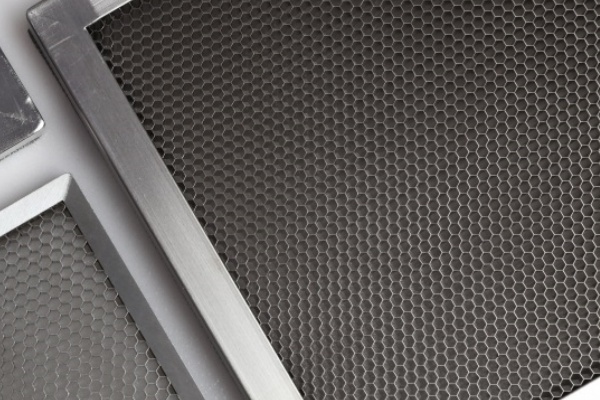
The idea isn't complicated. Instead of blocking signals with solid metal, you use geometry. The openings are sized and shaped so air flows through, but electromagnetic waves above a certain frequency can't make it.
It's called waveguide below cutoff. If a hole is narrow enough and deep enough relative to the wavelength, the wave hits the walls, bounces around, and loses its energy before it gets through. Air molecules don't care. They pass right through.
For 5G, that means the cells have to be smaller than older designs. Tighter tolerances. More precision in manufacturing. A plate that worked fine for 4G might not do anything useful at 28 GHz.
What I've Seen Go Wrong
I've pulled enough of these plates off cabinets to see the same problems show up over and over.
One is people picking the wrong frequency range. Someone grabs a standard vent off the shelf, bolts it on, and never checks whether it actually works at the bands their equipment uses. A year later, they're chasing interference problems and nobody thinks to look at the vent. But that's exactly where the leak is.
Another one is thermal cycling. These plates are metal. The cabinets are metal. They're bolted together with gaskets in between. The whole assembly heats up during the day, cools down at night. Over months and years, that expansion and contraction takes a toll. Gaskets harden. Bolts loosen. Gaps open up.
I've seen plates that looked fine from the outside but had a gap you could slide a piece of paper through where the gasket had given up. The shielding was gone. Nobody noticed until something started glitching.
Corrosion is another one, especially near the coast. Salt spray finds its way into the cabinet, or just sits on the outside of the plate. Aluminum starts pitting. The surface conductivity goes down. Shielding effectiveness drops. You don't see it happening day to day, but it's there.
What to Look For
If you're picking waveguide plates for 5G cabinets, here's what I've learned matters.
First, frequency. The plate needs to cover whatever bands you're running. For 5G, that's often up to 40 GHz. Some go higher. Check the numbers, but also ask what frequencies they actually tested at. Lab tests and real-world performance don't always line up.
Second, airflow. You want as much open area as possible while keeping the waveguide cutoff. Good designs get up around 80 or 90 percent open. That means the plate isn't strangling your cooling.
Third, material. If the cabinet is indoors or in a controlled environment, aluminum is fine. For outdoor cabinets—especially near salt water—you want 316L stainless or at least heavy-plated aluminum. Corrosion will kill a plate slowly, but it will kill it.
Fourth, the gasket. This one gets overlooked a lot. The plate itself can be perfect, but if the seal to the cabinet is bad, you've got a leak. Look for designs with compression gaskets, not just flat foam. Conductive gaskets help maintain electrical continuity around the whole perimeter.
Installation Is Where Things Go Sideways
You'd be surprised how many good plates get ruined by bad installation.
Uneven bolt torque is a classic. Someone tightens one side all the way down, then the other side, and the gasket compresses unevenly. You end up with a gap on one edge and over-compression on the other. Either way, the seal isn't right.
Mixing metals is another one. A stainless steel plate bolted to an aluminum cabinet without isolation creates a galvanic cell. The aluminum around the bolt holes corrodes over time. The plate stays tight until it doesn't.
And sometimes the mounting surface itself isn't flat. The cabinet door might be warped from years of sun and weather. You bolt a nice flat plate onto a warped surface, and you get gaps no gasket can fill.
What Manufacturers Are Doing
Some of the newer designs are getting smarter. Instead of a separate plate bolted onto the cabinet, some manufacturers are building waveguide structures directly into the cabinet walls. Fewer seams, fewer places for leaks.
Modular plates are showing up too. You can swap them out as frequency requirements change, rather than replacing whole cabinets. Makes sense if you're upgrading sites over time.
Testing is getting better as well. More suppliers are publishing data specific to 5G bands, not just a single shielding effectiveness number at one frequency. Insertion loss, VSWR, performance across the whole range the plate is supposed to cover. That's the kind of data that actually helps you pick the right part.
Bottom Line
Waveguide plates for 5G aren't a new idea, but the job has changed. Higher frequencies need tighter cell design. More power needs more airflow. Outdoor installations need materials that don't rot.
The plate that worked for 4G might not work now. And even a good plate won't perform if the installation is sloppy or the gasket is wrong.
When you're spec'ing these, check the frequency range. Check the material. Check how it seals. And when it goes in, make sure whoever's installing it knows what they're doing. Because once the cabinet is closed and the site is live, nobody's coming back to check that vent. It'll just start causing problems six months later, and someone will spend three days figuring out why.