To be a valuable global supplier
for metallic honeycombs and turbine parts


Contact number
0555-2813555

To be a valuable global supplier
for metallic honeycombs and turbine parts

Technological Innovation
Process Management
Continuous Improvement
Customer Satisfaction

Knowledge
Dedication
Diligence
Loyalty
Responsibility
Confidence
Tenacity
Respect

To be a valuable global supplier
for metallic honeycombs and turbine parts
Release time:2026-03-19
I've seen what salt air does to metal. You leave a standard vent panel on a coastal site for six months, and it starts looking like it spent years underwater. The honeycomb crumbles. The frame pits. And your shielding goes right along with it.
People forget this. They spec a vent based on shielding numbers alone, bolt it onto some equipment bound for a ship or a coastal radar station, and act surprised when it fails eighteen months later. Salt doesn't care about your datasheet.
If your gear's going near the ocean, you need vents built for it. Here's what that actually means.
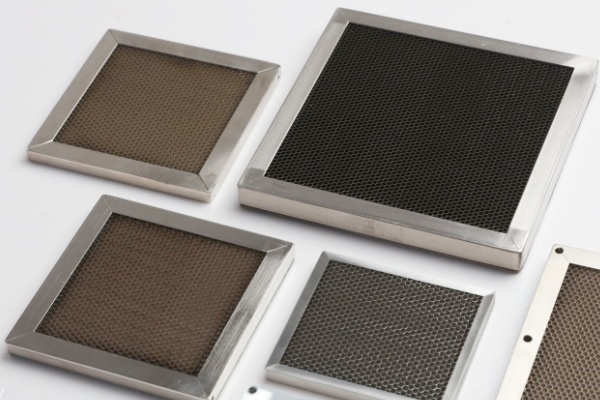
What Salt Spray Does to Regular Vents
Standard waveguide vents use aluminum. Good conductivity, lightweight, easy to manufacture. Works fine in a server room or a factory floor.
Put that same vent on a boat or a coastal tower, and things change. Salt accumulates in the honeycomb cells. Moisture sits there. Corrosion starts at the cell walls and spreads. The metal doesn't just look bad—it loses conductivity. Your shielding effectiveness drops. Eventually, the structure itself weakens and fails.
I've pulled corroded vents off marine gear where the cells had literally flaked away. Airflow still worked, sort of. Shielding was gone. Might as well have left the hole open.
What Makes a Vent Marine-Grade
You want a vent that survives salt spray? Start with the material.
Stainless steel 316L is the usual answer. It's got molybdenum in it, which helps resist chlorides. Salt water doesn't bother it the way it bothers aluminum or carbon steel. Corrosion rates down around 0.01 mm per year in salt spray, compared to 0.1 mm for regular steel .
Titanium works too if you've got the budget. Lighter than steel, even more corrosion-resistant. Usually overkill unless you're building subs or something that stays in the water full-time.
Some vents use aluminum with protective coatings. Nickel plating, chromate conversion, that sort of thing. Helps, but coatings can scratch or wear. Once the salt gets under the coating, it spreads fast. I'm cautious about coatings unless I know the installation won't see much handling.
It's Not Just the Honeycomb
The frame matters as much as the cells. A stainless honeycomb bolted into an aluminum frame with painted surfaces? You've created a galvanic cell. Salt water acts as electrolyte, and your vent becomes a battery. One metal corrodes faster to protect the other. Usually the aluminum loses.
You want continuity throughout. Frame and honeycomb made from compatible materials. Gaskets that seal moisture out, not just EMI in. Some marine vents use dual O-ring seals to keep salt fog from ever reaching the joint .
I've seen installations where the vent itself was fine, but the mounting surface corroded underneath because moisture sat between the frame and the enclosure. Proper gasketing stops that. IP68-rated seals exist for a reason.
Real Numbers, Real Difference
You can test this stuff. Standard salt spray testing runs 96 hours in 5% NaCl solution at 35°C, high humidity. Good marine vents come out looking like they went in. No corrosion, no blistering, no peeling .
Electrically, they hold up too. After salt exposure, a quality vent should show less than 0.1 dB change in insertion loss. VSWR shift under 0.05 . Basically, it performs the same after salt as before.
Compare that to standard vents. I've seen aluminum honeycomb start pitting within 48 hours in coastal air. Within a year, shielding can drop 20, 30, 40 dB depending on frequency. You don't notice it day to day. Then something interferes with your gear and you're tracing the problem back to a vent you should have spec'd better.
Where You Actually Need This
Obvious one is ships. Naval electronics, comms gear, radar. If it's on a vessel, it needs marine vents. No debate.
Coastal installations too. Base stations within a mile of the ocean. Lighthouses, weather stations, port facilities. Salt spray travels further than you think. I've seen corrosion issues miles inland during storms.
Offshore platforms, obviously. Oil rigs, wind turbines, research buoys. These things sit in the worst possible environment and need to keep working.
Chemical plants count as well. Not marine, but similar corrosives in the air. Same rules apply.
What the Data Shows
There's real research backing this up. Studies on silver-coated materials show that proper corrosion-resistant treatments let shielding hold up after days in salt solution. One recent paper demonstrated shielding effectiveness above 90 dB even after a week in NaCl at various pH levels . Another showed silver-coated composites surviving 96 hours of accelerated salt spray with zero visible corrosion .
That's the standard you're aiming for. Not just passing the test, but maintaining performance after.
Field data backs it up too. Ship radar installations using 316L vents with diamond-like carbon coatings showed less than 5% performance degradation after two years in the South China Sea. Traditional aluminum vents? Severe corrosion within six months .
The Cost Question
Marine-grade vents cost more. Stainless costs more than aluminum. Titanium costs more than stainless. Better seals add cost. Testing adds cost.
But here's the thing. Replacing a failed vent on a ship means dry docking sometimes. Means pulling equipment offline. Means troubleshooting interference that should never have happened. That cost dwarfs the upfront difference.
I've seen facilities switch from standard vents to marine-grade after one failure too many. They never go back. The math works out.
Bottom Line
If your equipment stays indoors in a controlled environment, buy standard vents. They'll do fine.
If it goes near salt water, spend the money on corrosion-resistant. 316L stainless. Proper sealing. Verified salt spray testing. It's not complicated, but it matters.
Salt is patient. It will find the weak spot. Don't let your vents be that spot.