To be a valuable global supplier
for metallic honeycombs and turbine parts


Contact number
0555-2813555

To be a valuable global supplier
for metallic honeycombs and turbine parts

Technological Innovation
Process Management
Continuous Improvement
Customer Satisfaction

Knowledge
Dedication
Diligence
Loyalty
Responsibility
Confidence
Tenacity
Respect

To be a valuable global supplier
for metallic honeycombs and turbine parts
Release time:2026-03-18
Look, if you've ever had to deal with both cooling and shielding at the same time, you know the drill. You need airflow, so you cut holes. Those holes wreck your shielding. So you add more metal somewhere else to compensate. Weight goes up. Cost goes up. And you're still not sure if it'll pass testing.
There's another way to think about this. Instead of fighting the vent, you make it part of the shield. That's what planar waveguide vents do. And they do it better than traditional methods for one simple reason: they use geometry instead of bulk .
The Old Way: Punch Holes and Hope
Traditional vent panels are straightforward. Take a sheet of metal, punch some holes in it, bolt it on. Air moves through the holes, and the metal blocks some of the interference.
For a long time, that was good enough. Frequencies were lower. Requirements were looser. A punched panel let you check both boxes well enough to get by .
But here's what happens at higher frequencies. Those holes stop being just holes. They become antennas. Every single perforation starts radiating energy out or letting interference in . The shielding you thought you had? Gone. And you're left wondering why your perfectly good enclosure suddenly leaks like a sieve.
Some designs try using wire mesh instead. Higher mesh count gives better shielding, but then your airflow drops fast . You're trading one problem for another.
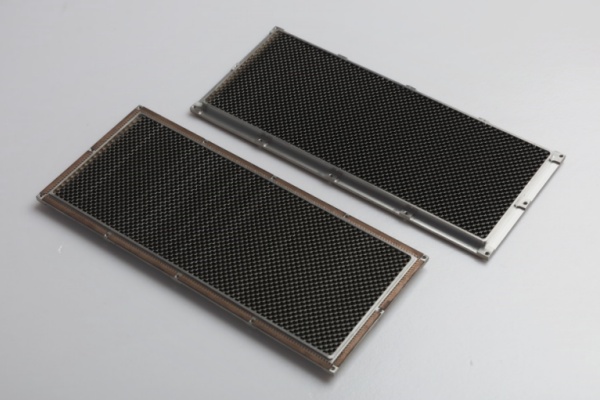
What Makes Waveguide Vents Different
A planar waveguide vent doesn't try to block signals with solid metal. Instead, it uses an effect called waveguide below cutoff .
Here's the short version. If you make the openings narrow enough and deep enough relative to the wavelength you're trying to block, electromagnetic waves literally cannot propagate through. They hit the channel, bounce around a few times, and lose all their energy before making it to the other side .
Air molecules don't care about waveguide cutoff frequencies. They flow right through. So you get ventilation and attenuation from the same structure, without adding heavy materials .
The geometry does the work, not the mass.
Stability Over Peak Numbers
This is something that doesn't get talked about enough. Peak attenuation numbers on a datasheet look nice. But what matters in the real world is whether the vent performs the same way after you install it, after it vibrates, after it goes through temperature cycles .
With punched panels, tiny variations in manufacturing or mounting can change how well they shield. How tight are the screws? How flat is the surface? How well does the panel sit against the gasket? All of it matters .
Waveguide vents are more forgiving. Because the attenuation comes from channel geometry, not contact pressure or surface finish, the performance stays consistent . The dimensions hold, the attenuation holds.
In aerospace work especially, this matters. Launch vibration, thermal cycling, long service intervals – lightweight structures have to hold their shape. Slightly lower but stable attenuation is often preferred over higher performance that drifts .
Where You See the Difference
Put a planar waveguide vent next to a standard perforated panel and run a spectrum analyzer on both. The difference jumps out at you.
At lower frequencies, they might look similar. But crank the frequency up into gigahertz range, and the waveguide vent keeps working while the punched panel starts leaking .
That's why you find these vents in 5G gear, military enclosures, medical equipment that can't afford interference messing with sensitive readings . Anywhere that runs hot and has to pass strict EMC testing, basically.
In medical devices especially, small unstable emissions can cause hard-to-trace issues over time. Keeping shielding continuous at the vent helps reduce that variability .
What It Takes to Get It Right
Waveguide vents aren't magic. They need to be designed for your specific frequencies. The channel dimensions have to match whatever signals you're trying to block. Get that wrong and you're just adding cost without fixing the problem .
Material choice matters too. Aluminum is common – conductive enough, light enough, easy to form into precise channels . But thin aluminum walls can shift slightly under mounting load or vibration. When dimensional stability becomes critical, designers sometimes switch to stainless or reinforced variants .
And don't forget the interface. A perfect vent panel bolted onto a leaky enclosure is still a leaky enclosure . The vent frame has to maintain continuous conductive contact with the enclosure. Gaps, uneven pressure, oxidation – all of it creates leakage paths .
Some manufacturers recommend soldering or brazing for permanent installations. Others use conductive gaskets with fasteners spaced close together . Either way, the connection matters as much as the vent itself.
The Bottom Line
Here's what I've learned watching people deal with this stuff. When you're pushing higher frequencies and higher power densities, the old compromises stop working. You can't just punch holes and hope for the best.
Planar waveguide vents solve the problem differently. They let air move while blocking signals, using geometry instead of bulk. They stay consistent over time and across environments. And they turn the vent from a weak point into part of the shield .
If you're designing gear that has to both breathe and stay tight, that's worth looking at.