To be a valuable global supplier
for metallic honeycombs and turbine parts


Contact number
0555-2813555
To be a valuable global supplier
for metallic honeycombs and turbine parts
Technological Innovation
Process Management
Continuous Improvement
Customer Satisfaction

Knowledge
Dedication
Diligence
Loyalty
Responsibility
Confidence
Tenacity
Respect

To be a valuable global supplier
for metallic honeycombs and turbine parts
Release time:2025-12-29
When working with a DOC catalytic converter, the honeycomb structure is usually the first thing engineers focus on. From the outside, most DOC units look similar, but once you start dealing with exhaust flow, temperature, and long-term durability, the details of the honeycomb design become hard to ignore.
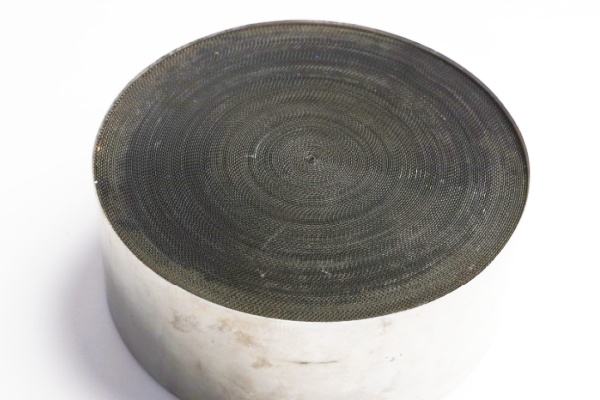
A DOC catalytic converter relies on direct contact between exhaust gas and the catalyst coating. The honeycomb structure is what makes this possible. By dividing the exhaust stream into hundreds or thousands of small channels, the substrate creates a large active surface area without blocking flow. If the channel design is wrong, the converter either becomes too restrictive or fails to convert emissions efficiently.
Cell density plays a major role here. Higher cell densities increase surface area, which helps oxidation reactions for CO and hydrocarbons. At the same time, too many cells can raise backpressure, especially in engines with high exhaust flow. In practice, DOC catalytic converters used on heavy-duty diesel engines often favor a balance—enough cells to support conversion, but not so many that exhaust flow becomes unstable at high load.
Wall thickness is another factor that tends to be underestimated. Thin walls improve heat transfer and allow the DOC catalytic converter to reach operating temperature faster. That matters during cold starts and low-load operation. However, thinner walls are more sensitive to vibration and thermal cycling. On engines that run long hours or experience frequent load changes, slightly thicker walls often provide better durability, even if warm-up takes a bit longer.
Uniform flow through the honeycomb structure is critical. Uneven flow creates hot spots, and hot spots shorten the life of both the substrate and the coating. Engineers usually pay close attention to inlet cone design and mounting alignment to make sure exhaust gas spreads evenly across the face of the DOC catalytic converter. Problems here don’t always show up immediately, but over time they lead to cracked substrates or localized coating failure.
Material choice also affects honeycomb design decisions. Metallic substrates handle vibration well and tolerate rapid temperature changes, which is useful in mobile and off-road applications. Ceramic substrates offer excellent thermal stability and are commonly used where exhaust temperatures stay high for long periods. The honeycomb geometry has to match the material, otherwise mechanical stress builds up during operation.
Coating performance depends heavily on the honeycomb surface. A well-designed structure allows the washcoat to bond evenly and stay in place. Poor surface preparation or inconsistent channel geometry can lead to coating loss, which directly reduces the efficiency of the DOC catalytic converter. This is why honeycomb design and coating process are usually developed together, not as separate steps.
In real applications, the best honeycomb design is rarely the most aggressive one on paper. It is the design that survives vibration, thermal shock, and long operating hours while keeping pressure drop under control. A DOC catalytic converter that performs steadily over time is more valuable than one that looks impressive only in lab conditions.
For emission control systems, honeycomb structure design is not just a geometric exercise. It directly affects efficiency, durability, and reliability. In DOC catalytic converters, getting this balance right is what makes the difference between stable operation and early failure.