To be a valuable global supplier
for metallic honeycombs and turbine parts


Contact number
0555-2813555
To be a valuable global supplier
for metallic honeycombs and turbine parts

Technological Innovation
Process Management
Continuous Improvement
Customer Satisfaction

Knowledge
Dedication
Diligence
Loyalty
Responsibility
Confidence
Tenacity
Respect

To be a valuable global supplier
for metallic honeycombs and turbine parts
Release time:2026-02-27
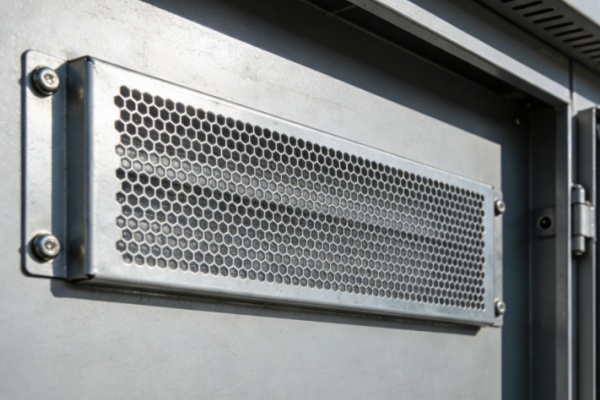
Look, if you're designing electronics that run hot and run fast, you've probably run into this problem: you need to let air in to cool things down, but every hole you cut is another chance for EMI to leak out.
For years, the fix was simple. Punch some holes in a metal sheet, bolt it on, call it a day. And honestly? That worked fine. Back when frequencies were lower, a perforated panel let air move and kept most of the interference inside. Good enough.
But "good enough" doesn't cut it anymore. Not with 5G gear pushing higher frequencies. Not with sensitive electronics packed into tighter spaces. Those old punched holes? They're causing problems now.
So what's actually happening?
Here's the thing about electromagnetic waves at high frequencies: they're sneaky. They don't need a big opening to escape. Once the signal's wavelength gets short enough, even a small hole starts looking like an open door. Every single perforation in a standard vent panel becomes a tiny antenna, leaking energy out (or letting interference in).
That puts engineers in a nasty spot. Open the panel up to keep components cool, and your shielding falls apart. Seal it up tight to pass EMC testing, and everything cooks. With traditional sheet metal, you're stuck choosing one or the other.
Waveguide vents do something different
A waveguide ventilation panel doesn't just give you a different hole pattern. It works on a different principle entirely.
Without getting too deep into the physics, here's the short version: if you shape the openings a certain way—specific width, height, depth—they stop acting like holes and start acting like filters. Electromagnetic waves above a certain frequency literally cannot get through. They hit the opening and just... stop.
Air? Air flows right through. Air molecules don't care about waveguide cutoff frequencies.
That's the whole trick. Instead of an open window, you get a structured path that lets air move while blocking specific frequencies. Ventilation and shielding finally stop fighting each other.
What that means in practice
The big difference you'll notice with waveguide vents is consistency.
Punched sheet metal is unpredictable. Tiny variations in manufacturing, how tight the screws are, even how the panel sits against the gasket—all of that can change how well it shields. Waveguide structures are more forgiving. Design them right, and you know exactly which frequencies get blocked and which don't.
And because airflow depends on how many channels you have, not how big you make them, you can scale cooling without wrecking your shielding. That's huge for high-power gear that needs serious airflow.
Where you actually see these
Walk into any telecom site with 5G gear, and you'll probably find waveguide vents on the cabinets. Same with military enclosures, industrial drives that switch at high frequencies, even medical equipment that can't afford interference messing with sensitive readings.
Anywhere that runs hot and has to pass strict EMC testing, basically.
A few things to watch out for
If you're thinking about using these, keep a couple things in mind.
First, you need to know your frequencies. The vent geometry has to match whatever signals you're trying to block. Get that wrong and you're just adding cost without fixing the problem.
Second, waveguide vents do restrict airflow more than open holes. Not dramatically, but enough that you should run the numbers instead of guessing.
Third, the interface matters. A perfect vent panel bolted onto a leaky enclosure is still a leaky enclosure. Make sure the mounting seals properly.
Waveguide vents aren't magic. They're just a smarter way to handle a problem that old methods can't solve anymore. For high-frequency, high-power gear, they let you cool things without turning your cabinet into an antenna.