To be a valuable global supplier
for metallic honeycombs and turbine parts


Contact number
0555-2813555
To be a valuable global supplier
for metallic honeycombs and turbine parts
Technological Innovation
Process Management
Continuous Improvement
Customer Satisfaction

Knowledge
Dedication
Diligence
Loyalty
Responsibility
Confidence
Tenacity
Respect

To be a valuable global supplier
for metallic honeycombs and turbine parts
Release time:2025-12-02
When people talk about DOC systems, the first thing they usually mention is the catalyst coating — platinum, palladium, loading levels, formulas. That makes sense. On paper, that’s where the “chemistry” happens.
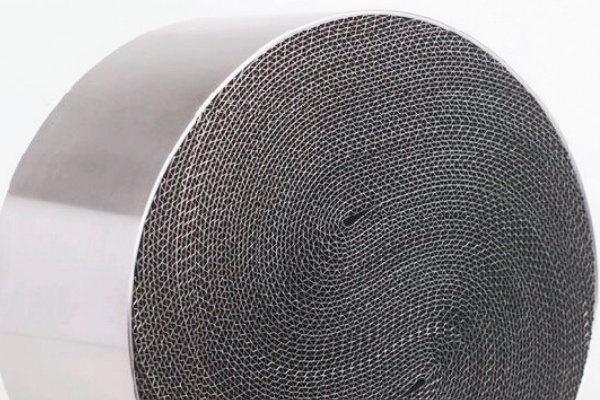
But if you’ve ever worked around real engines long enough, you start to notice something else: two DOCs can use very similar catalyst formulas and still behave very differently on the same machine. And most of the time, the difference isn’t on the surface. It’s inside the DOC metal substrate, in the honeycomb itself.
The honeycomb structure is basically the road that exhaust gas has to travel through. If that road is too narrow, too twisted, or poorly built, it doesn’t matter how good the catalyst is — the gas simply doesn’t flow or react the way you want.
Cell density is a good example. On paper, higher CPSI means more surface area, and more surface area means better conversion efficiency. In a controlled lab test, that’s usually true. But in real applications — generators under heavy load, forklifts in a warehouse, construction machines on rough ground — the situation is different. Higher CPSI often means higher backpressure. Some engines can handle that. Others can’t, and they will slowly lose efficiency, run hotter, or consume more fuel.
So the “best” cell density is not the highest one. It’s the one that matches the engine’s size, exhaust flow and duty cycle. In many industrial cases, a mid-range structure performs better in the long run than an ultra-dense one.
Then there’s the shape of the channels themselves. A good DOC metal substrate has channels that are consistent and well aligned. That means exhaust gas spreads evenly across the whole cross-section. When that happens, the catalyst layer ages more uniformly and the temperature inside the converter stays more stable.
If the geometry is poorly controlled, gas doesn’t flow evenly. It finds the easiest paths and avoids others. Over time, some parts of the substrate work much harder than the rest. Those areas get hotter, wear faster, and eventually start to break down. From the outside everything still looks fine, but performance slowly fades.
Vibration is another reality that never shows up in technical brochures. Industrial and off-road equipment are always shaking. If the internal honeycomb structure isn’t strong enough, the thin metal foils can start to deform. It happens very slowly, so you don’t notice it right away. But months later, channels may collapse, coatings may crack, and efficiency drops without a clear “single failure point.”
This is why the internal corrugation design, the way the metal foil is formed and supported, actually matters just as much as the catalyst itself.
Heat behaviour also depends heavily on geometry. A well-designed honeycomb spreads heat more evenly through the DOC metal substrate. That reduces local hot spots, especially during sudden load changes or cold starts. In real life, that stability is what protects the substrate and the coating from early aging.
So when you look at a metal substrate, you’re not just looking at a support for a catalyst. You’re looking at a core that decides how gas flows, how heat moves, and how long the system will survive out in the field.
Most of the time, when a DOC system works perfectly, nobody notices the honeycomb geometry inside it. And that’s actually the best sign that the design is right. Because a good honeycomb doesn’t try to show off. It just quietly does its job, hour after hour, year after year.